Bird observations
Bird species on our farms in Mönchaltorf (Eichhof) and on the Adlisberg — with profiles, filters and live data from our observations.
HofLabor is a Swiss on-farm innovation project for mosaic farming — a cultivation system that combines biodiversity and food production on the same land. We develop machines, methods and digital tools for biodiverse, pesticide-free farming and healthy soils — with controlled traffic farming, strip cropping and mulch. We test everything in the day-to-day running of the pioneer farm SlowGrow, on more than 60 hectares in Mönchaltorf and on Adlisberg (Zurich).
 For products from mosaic farming, or to take part in the field: the pioneer farm SlowGrow
SRF Einstein
1 October 2026, 21:05, SRF 1
The episode is in German.
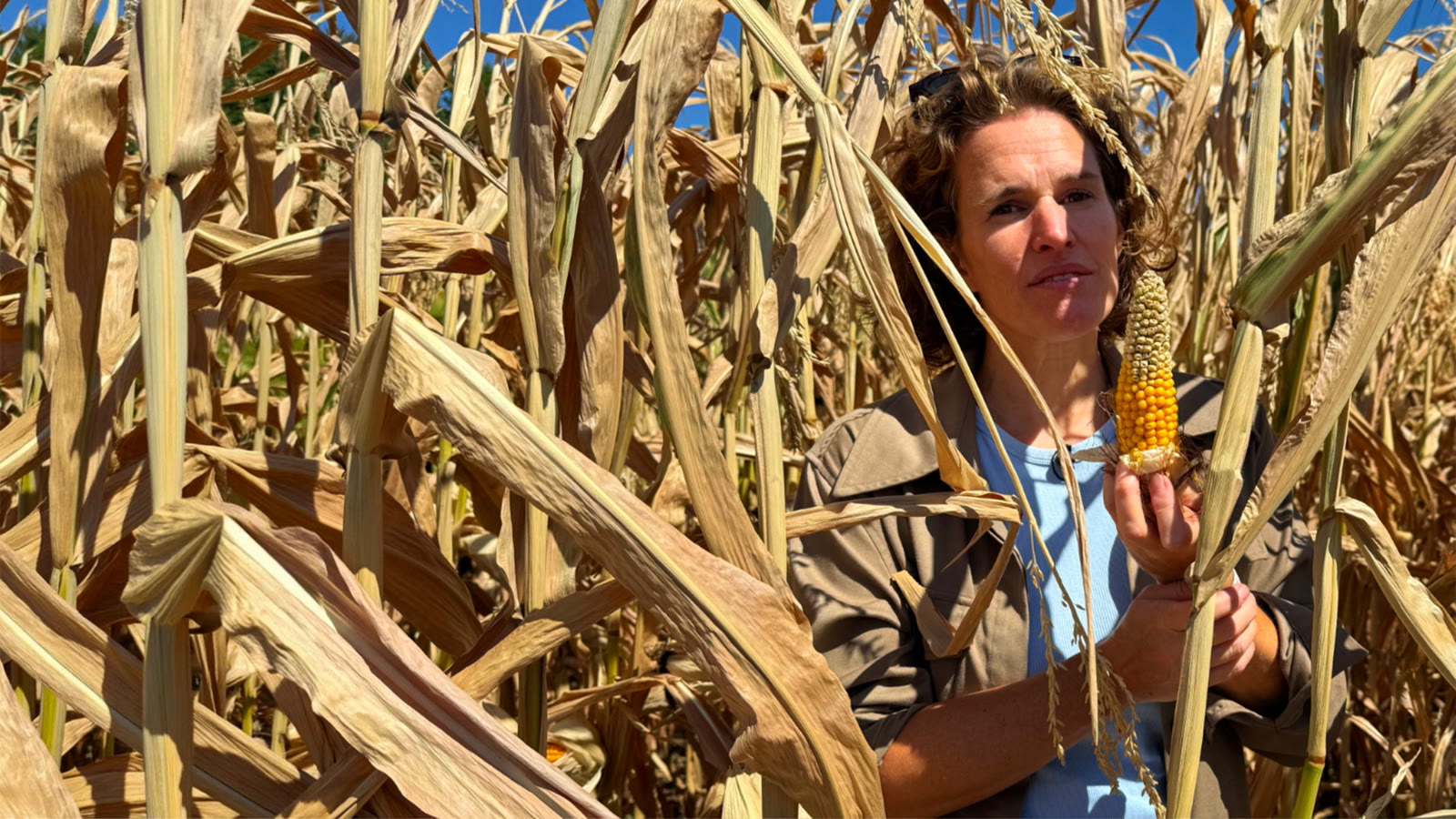
SRF Einstein filmed at HofLabor in Mönchaltorf. The episode shows our onion crop grown in mulch, largely without artificial irrigation, and without fertilizers or pesticides. Tractors run on fixed GPS lanes. Vegetables and grains grow in strips.
The episode also shows, in an experiment, that the soil under the mulch is still in good condition after the summer – unlike the soil without mulch. We also show how we can still weed in the mulch with the Raptrac – decisive for the yield, especially in crops such as onions.
Mosaic farming
Today, nature conservation and food production are unfortunately often at odds. Environmental goals relating to air, water and soil pollution, biodiversity loss and climate change are systematically missed.
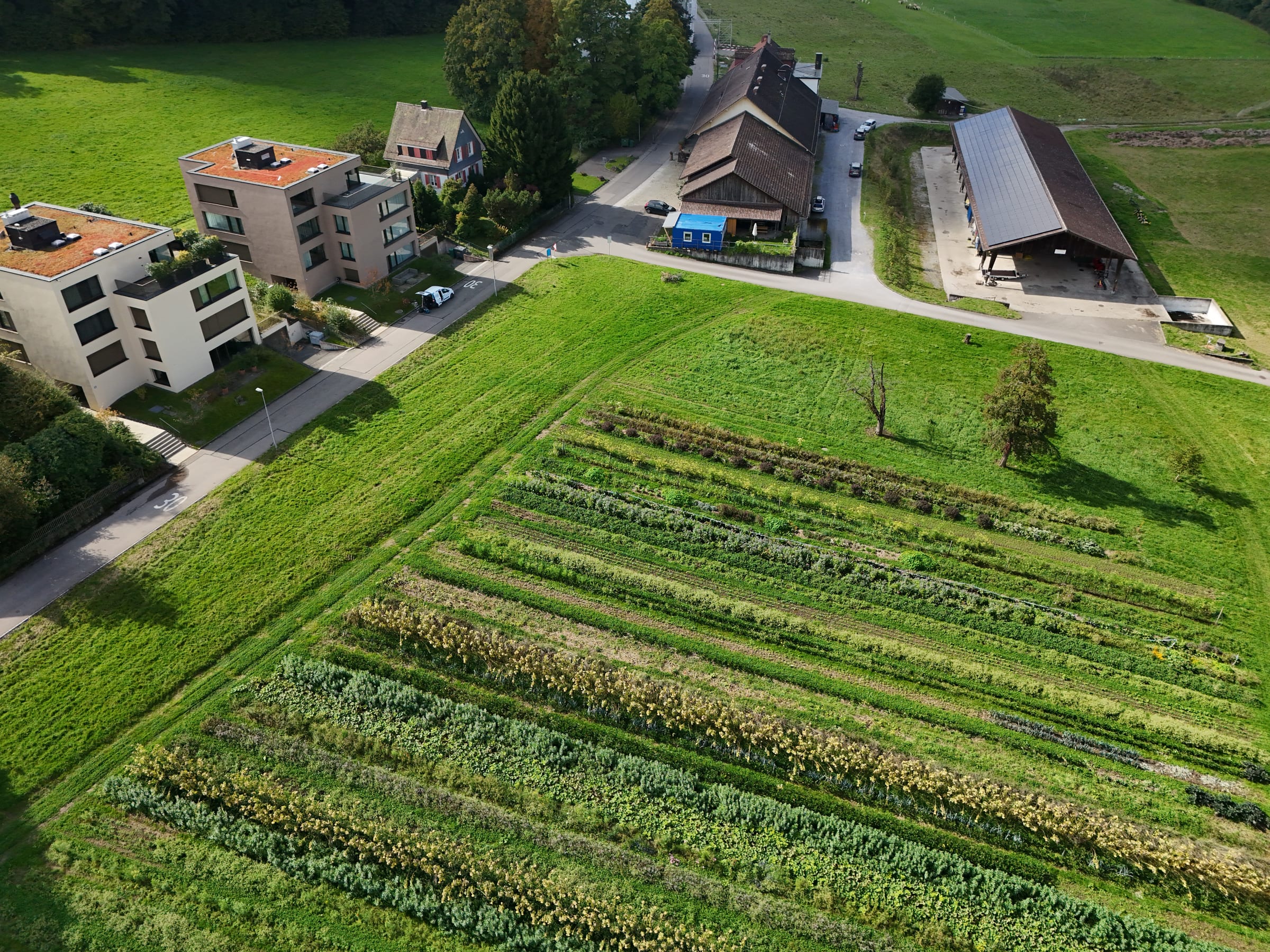
With regenerative mosaic farming we aim to develop a new system that can resolve this conflict. Using a combination of controlled traffic farming, diverse strip cropping, soil-conserving cultivation and large-scale mulching systems, we currently produce vegetables, grains and potatoes without fertilizers or pesticides on over 20 hectares.
Every tractor pass compacts the soil. That is why all our machines use GPS to navigate fixed lanes (controlled traffic farming). This leaves 70% of the area untouched. Soil life can regenerate and build soil structure. Water is absorbed more effectively, plants can freely expand their roots and find symbiotic partners, water and nutrients. This also increases yields.
Uniform fields offer little habitat. Many species disappear, while pests can easily spread. With strip cropping and the promotion of diverse field flora, we create a functional ecosystem in the field. Animals such as insects and spiders find food and shelter there year-round. This diversity helps to naturally regulate pests and diseases.

Through green manure, undersowing and seamless crop rotation, we ensure the soil is continuously penetrated by roots. This keeps the soil life active and diverse. We also mimic leaf fall with mulch, a layer of materials such as hay or grass clippings. This protects the soil from drying out and heavy rain, suppresses weeds and nourishes the soil organisms.
Controlled traffic farming and permanently covered soil preserve soil structure and soil life. This creates a functioning ecosystem of microorganisms, fungi, insects and soil fauna. Diseases and pests are not controlled chemically, but limited through ecological regulation. We deliberately avoid readily soluble fertilizers. Nutrients are provided within the system through symbiotic relationships, legumes, mulch and other biomass. Weeds are controlled mechanically.
HofLabor — our farm lab
Our approaches are not new, and many farmers are experimenting with strip cropping, green manure, soil-conserving cultivation, mulching and biodiversity elements. However, for these approaches to become robust methods that enable reliable production, further development is needed — in machinery, methods and digital management tools. With HofLabor we aim to navigate this learning curve so that others can build upon it. To this end, we collaborate with a network of farmers, research institutions and machinery developers.

We develop agricultural methods and machinery that regenerate soils, manage weeds and pests without pesticides, and enable efficient production. Our projects include an RTK-GPS retrofit kit, a modified power harrow for controlling perennial weeds, and new machines for efficient mowing and mulching in strip cropping and undersown crops.

We develop and test various apps for field planning, crop and machine tracking, knowledge management and marketing. We primarily use no-code tools like Glide and AppSheet and experiment with the possibilities of AI.
We are building a network of innovative farmers who believe that the future of agriculture is biodiverse, and who develop and test these approaches together with us. Within this pioneer network we also share machinery.
We measure our impact not only against environmental targets but also against economic feasibility. To this end, we compare our costs with available data from contribution margin calculators. We assess soil quality primarily through spade samples. Together with partners such as ETH Zurich, Agroscope and FiBL, we are also testing new methods for monitoring soil activity, biodiversity and weed development.
Impact
We measure our impact not only against environmental targets but also against economic feasibility. To this end, we compare our costs with available data from contribution margin calculators. We assess soil quality primarily through spade samples. Together with partners such as ETH Zurich, Agroscope and FiBL, we are also testing new methods for monitoring soil activity, biodiversity and weed development.
Bird species on our farms in Mönchaltorf (Eichhof) and on the Adlisberg — with profiles, filters and live data from our observations.
Over 1,000 species of fungi, bacteria and soil animals, made visible through their DNA — six concrete findings from the 2024 soil samples.
Since 2024 we have been leasing a 40 ha farm from the city of Zurich. Right next to the Dolder, on the Adlisberg, a demonstration farm is taking shape. Mosaic farming is meant to become tangible here for farmers, restaurateurs, researchers and the public. Through guided tours and events we create a space for knowledge sharing and collaborative development of the idea.
HofLabor on SRF Einstein
On 1 October 2026 HofLabor was on SRF Einstein, filmed in Mönchaltorf. Here is the video "Extremwetter: Wie retten wir unsere Ernten?".
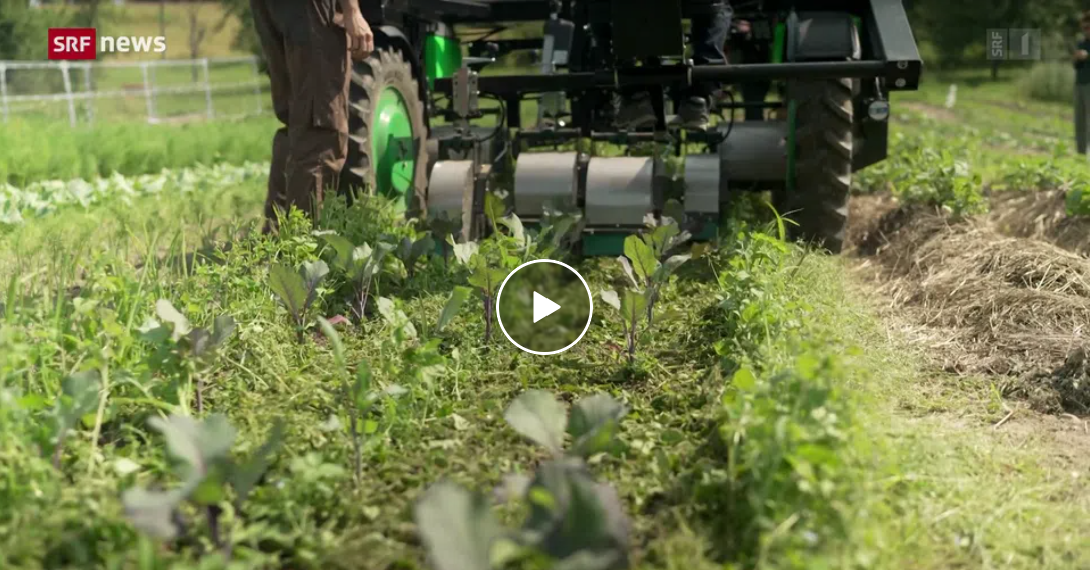
HofLabor on 10vor10 «die Idee»
On 25 July 2025 HofLabor was featured on SRF in the 10vor10 segment. Here is the video and the accompanying blog post «HofLabor tinkers with the field of the future».
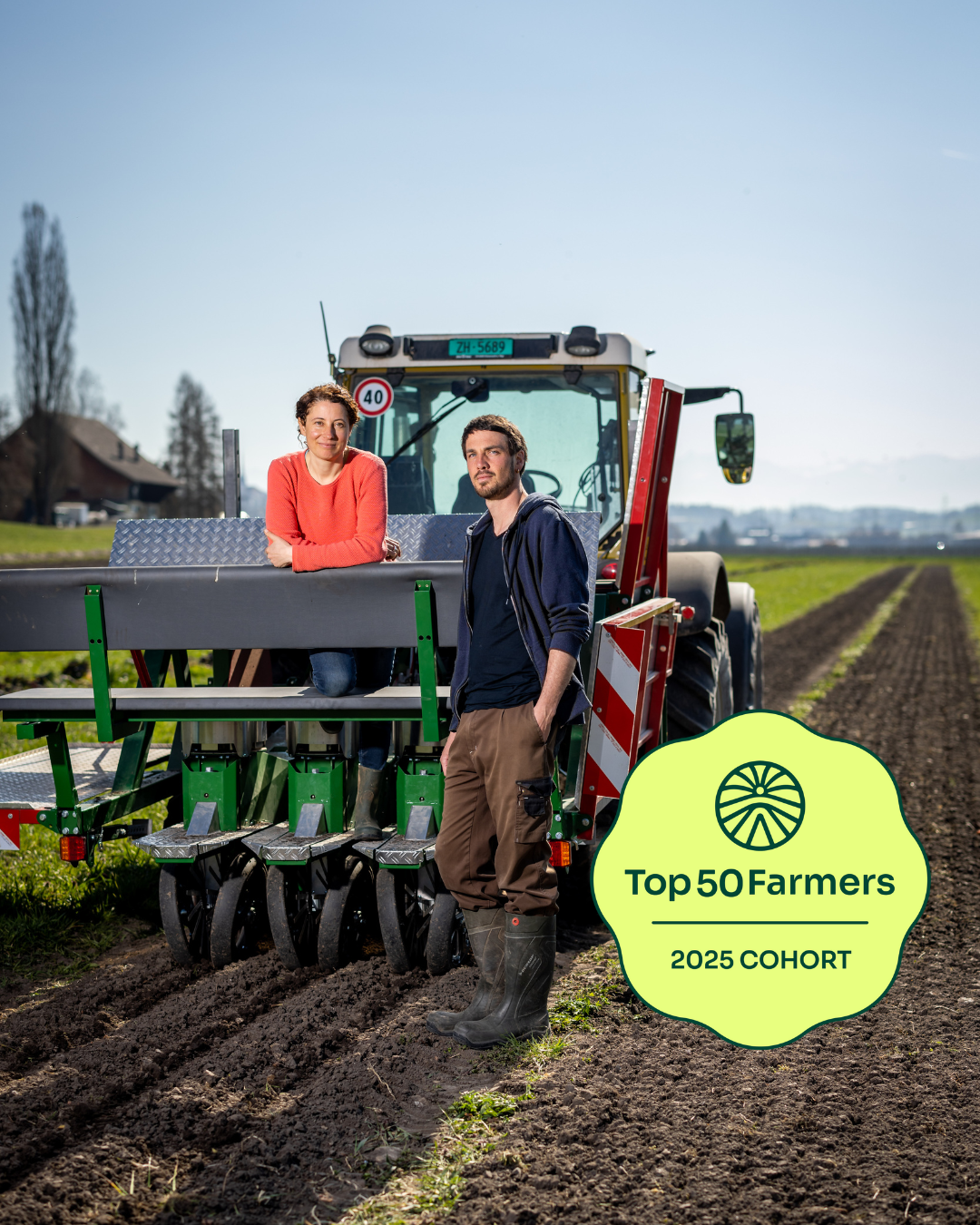
Top 50 Farmers in Europe 2025
Top 50 Farmers highlights diverse regenerative role models shaping the future of agriculture in Europe.
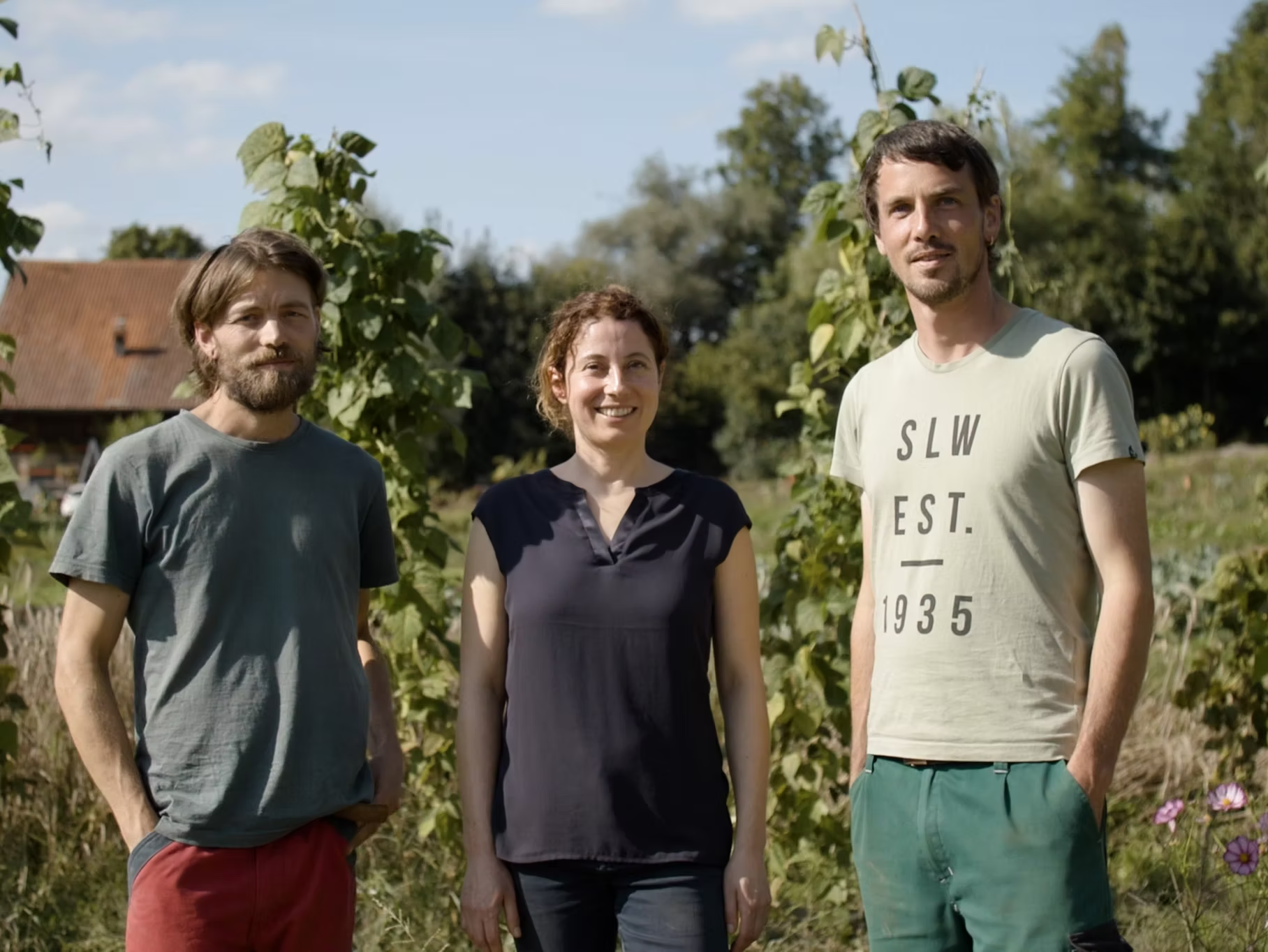
Prix Climat 2022
Together with SlowGrow we won the first Prix Climat, an initiative of the Klima Allianz.

Seedling Foundation supports initiatives and organizations that develop and implement innovative solutions for climate protection. Nurture – Inspire – Empower is the guiding principle for its philanthropic engagement. The focus is on the food system (agro-food sector). In Switzerland and neighbouring Europe (focus on Switzerland), SEEDLING is active in the following four areas: sustainable food production, sustainable & healthy nutrition, food waste & circular economy, climate awareness & climate justice.

Founded in 2020 by Thomas Schmidheiny and his four children, Fourfold consolidates the family's diverse philanthropic efforts and realizes their long-term vision of a healthy and equitable world that respects all forms of life. The foundation is committed to protecting the valuable resources of our planet and the right of all people to a dignified and fulfilling life. Fourfold empowers individuals and communities by providing access to education, entrepreneurial opportunities, scientific solutions and movement-building geared towards advancing sustainability.

KlimUp is a funding programme of the City of Zurich. It supports start-ups and non-profit organizations (NPOs) that contribute to the city's climate protection goals or the environmental goal of intelligent resource use.
The vision of the Leopold Bachmann Foundation is a world in which all people have the opportunity to acquire knowledge and develop their skills. The foundation aims to provide people, regardless of their background, with a secure livelihood and source of income, enabling them to shape their future successfully and make a valuable contribution to their communities. To this end, it supports organizations and companies in the fields of education, innovative entrepreneurship and agroecology, together with a global network of partners.
Enabled by
The Migros Pioneer Fund supports sustainable solutions for societal challenges with the goal of initiating systemic change towards a future-oriented society. The impact-oriented funding approach combines financial support with active funding and risk management. The fund is part of the social commitment of the Migros Group and has an annual budget of approximately CHF 15 million. It is supported by companies of the Migros Group such as Denner, Migros Bank, Migrol, migrolino and Ex Libris. More information: www.migros-pionierfonds.ch



Contact
Do you work in agriculture and are interested in our methods? Do you have a research project and are looking for a partner organization?