Mosaic farming
Fundamentals of Mosaic Farming
We collect and document our methods.
Controlled Traffic Farming (CTF)
Goal
- Minimising soil compaction
- Breaking the plough pan
Approach
- Permanent lanes with RTK GPS
- Uniform track width for all machines (1.77 m in our case)
- Shallow, soil-conserving tillage
Effects
- Soil regeneration between the lanes
- Improved water retention and reduced erosion
- Free root expansion, reduced plant stress
CTF as a basis for mosaic farming
Thanks to CTF, we are observing a steady improvement in soil structure on our fields. As pores develop over time and are no longer compacted, water can percolate and air can reach the roots. Deep-rooting plants also loosen the subsoil. Heavy tillage operations such as ploughing become unnecessary.
The CTF forms the basis for regenerative mosaic farming. Only a physically intact soil infrastructure allows for a vibrant soil biology.
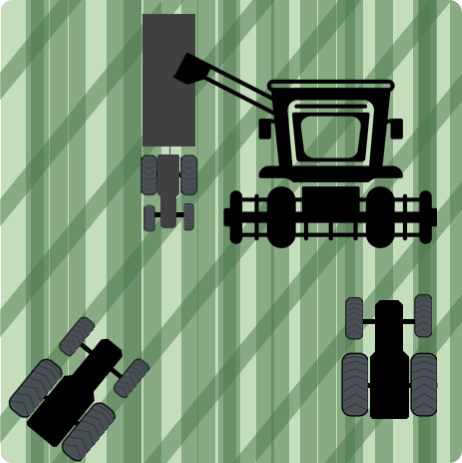
In Random Traffic Farming, 85% of the area is driven on each year.
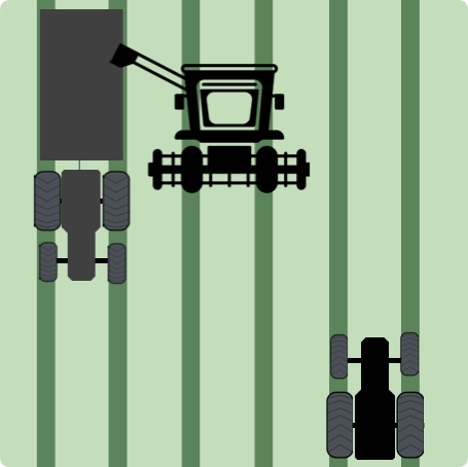
With CTF on permanent lanes, 70% of the area is never driven on.
Together with our partner, we have developed a retrofit kit for tractors for GPS steering with RTK.

Strip cropping and diversity
Goal
- Habitat and food sources for beneficial insects within walking distance of the crops
- Predator–prey balance
Approach
- Small-scale layout with narrow strips (1.77 m)
- Ideally, an evergreen system with plants in various growth stages
- No pesticides or readily soluble fertilizers!
- Where possible: Tolerating weeds
- Installation of structures (hedges, flower strips, etc.)
Effects
 Increased stress tolerance of plants through mycorrhizal symbioses
 High density of pollinating insects
 Natural pest control through a healthy beneficial insect population
 Increased soil fertility through a diversity of earthworms, bacteria and fungi
Biodiversity as an important production factor
The CTF allows individual tillage and planting of separate strips. The resulting mosaic continuously offers a diverse range of habitats for insects, spiders and other animals.
A stable population of beneficial insects regulates diseases and pests. Avoiding pesticides and readily soluble fertilisers (including slurry or farmyard manure) is a prerequisite for this diversity and thus for the system's self-regulation.
Mulch and root penetration
Goal
- Buffering weather extremes
- Reducing weeding effort
Approach
- Use of local materials, e.g. wood chips, leaves, grass clippings, green manures and straw
- Living roots in the soil wherever possible
- Where possible, also use material grown directly in the bed (in-situ mulch)
Effects
 Cool and humid microclimate under the mulch, even on hot days, reduced evaporation
 Protection against erosion during heavy rainfall
Continuous nutrient release from biological conversion
Protection against erosion during heavy rainfall
Continuous nutrient release from biological conversion
 Weed suppression through light reduction at ground level, reduced weeding effort
What is mulch?
- Mulch means biomass as a layer on the bed.
- Mulch is an imitation of leaf fall — established biological processes can be used.
Large-scale use of mulch
Although known in horticulture for centuries, mulch has not been widely used in agriculture until now. With a converted loader wagon, we can distribute mulch mechanically. Using the MulchTec Planter, we can then plant directly into the mulch. We use mulch at scale for potatoes and many field vegetables (celery, onions, beets, etc.).
Evergreen system
Photosynthesis forms the basis for biomass production and carbon input into the soil. This potential is utilised when the soil is permanently covered with living plants and root exudates are incorporated into the soil. Green manures, undersown crops, vegetated wheel tracks and other elements are part of a system that is as evergreen as possible.
To further increase soil cover, we are also testing undersowing in vegetable cultivation. Technical developments such as inter-row mulchers, which control weeds or undersown crops between the vegetable rows, expand the practical feasibility of this.
No pesticides or readily soluble fertilizers
Goal
- Building a functional ecosystem
- Natural balance of beneficial and harmful insects
Approach
- Mechanical weed control where necessary
- Nutrient input from legumes, mulch, insects and other biomass
- Resilient plants thanks to the interplay of CTF, diversity and mulch
Effects
Avoiding pesticides and readily soluble fertilisers is part of the system and a prerequisite for its ability to self-regulate. Under these conditions, biodiversity and symbioses emerge.
Nutrients are not dissolved in the soil, but are constantly transformed by soil life and made available to the plant when it needs them. This reduces the risk of leaching and over-fertilisation.